

https://issuu.com/fashion_ecomarket/docs/fashion_magazine_n_2_2025?fr=sZTk3ZDg2Mzc5OTU
FASHION MAGAZINE MILANO nr.2 JUNI 2025 pag.78
INTERVIEUW door BIGOTTA.
1 – U richtte VM Art op in 2016. Hoe is dit idee ontstaan?
Wat zou u hebben gedaan als u dit niet had gedaan?
VM Art werd officieel opgericht in 2016, maar de wortels ervan gaan veel verder terug. Rond 2002 creëerde ik M€URO (ME & EURO), een autobiografisch personage dat mijn reflecties op de hedendaagse samenleving belichaamt — culturele homogenisering, de macht van de media en vooral hoe ons voortbestaan afhankelijk is van geld.
Het lichaam van M€URO weerspiegelt dit perfect: een wezen dat alleen kan bestaan door consumptie — een tragikomisch icoon van onze tijd.
In het begin tekende ik scènes uit mijn leven, gezien door de ogen van M€URO, op tegels die ik had gerecupereerd tijdens de renovatie van mijn appartement, of ik werkte op plastic dragers met verf.
Een van de eerste werken ging over een reis naar Rome waarbij mijn Nissan Micra panne kreeg op de snelweg. Een vriend duwde de auto kilometers ver — een surrealistische scène die ik omzette in een mini graphic novel in M€URO-stijl.
Van daaruit ontstonden vele andere verhalen — zoals de liefdesaffaire tussen M€URO en Miss Dollarina — en ik droomde zelfs van een animatieversie, inclusief 3D, door storyboards te tekenen en beweging te bestuderen.
Na jaren in architectuur en design, met abstracte kunst als parallelle praktijk, verhuisde ik naar het Caribisch gebied. In 2016 nodigde een dierbare vriend, Edoardo Hidalgo (dezelfde die de Micra had geduwd!), mij uit naar Shanghai om samen te werken aan een groots stedelijk ontwikkelingsproject. Hij moedigde mij aan om mijn tekeningen weer op te pakken — hij had ze zien ontstaan.
Dat was het moment waarop ik besloot M€URO de wereld in te brengen door hem op T-shirts te drukken. Dat was de eerste stap richting VM-SHIRT.
Als ik dit niet had gedaan? Dan was ik waarschijnlijk nog steeds op zoek naar manieren om kunst, activisme en satire te combineren — instrumenten die voor mij altijd onafscheidelijk zijn geweest van het leven.
Want vrij zijn… is een daad van rebellie.
2 – Tegenwoordig zijn kleurrijke T-shirts met prints overal te zien.
Wat maakt die van u anders? Wat inspireert u?
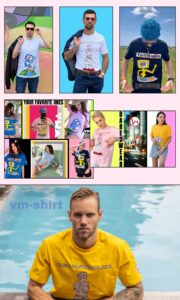
Mijn T-shirts zijn persoonlijke verhalen. Elk ontwerp is een boodschap — vaak provocerend of surrealistisch — ontstaan uit mijn ervaringen, mijn meest radicale gedachten en één verlangen: het alledaagse transformeren tot levende kunst.
Terwijl velen dromen van het veranderen van de wereld, is mijn droom om een spoor achter te laten via een totaalwerk — een conceptueel monument dat tegelijk een herinnering en een waarschuwing is.
Ik stel me een performatieve installatie voor: een zwevende metalen structuur — een fragiel symbool van democratie — bedekt met brandende bankbiljetten, midden op Times Square. Wanneer het vuur dooft, blijft de kale structuur hangen, een stille getuige van een noodzakelijk vuur.
Mijn graphics zijn niet gemaakt om te “behagen”, maar om te communiceren, te provoceren en aan te zetten tot denken — soms met ironie. Ze zeggen wel eens: “misery loves company”, maar ik wil dat die “company” ook bewustzijn is.
Daar is ook M€URO, mijn artistieke alter ego: kritische observator, slachtoffer en verteller van onze tijd. Via hem vertel ik verhalen — alsof ik schrijf en Keith Haring tekent.
Haring is mijn visuele sneltaal: zijn directe, universele beeldtaal vertaalt mijn ideeën perfect.
Esthetisch werk ik met felle kleuren, scherpe contrasten en een mix van popart, strips en underground graphics, met digitale invloeden. Maar wat mijn T-shirts echt onderscheidt, is de benadering: het is geen mode — het zijn draagbare boodschappen.
3 – Volgend jaar bestaat uw merk 10 jaar.
Wat waren de belangrijkste mijlpalen en wat komt er nu? Wie is uw typische klant?
Ja! VM-SHIRT is nog steeds een kind van 10 jaar — maar 2026 markeert het jubileum van een idee dat voortdurend is geëvolueerd zonder zijn ziel te verliezen.
De belangrijkste mijlpalen zijn allemaal verbonden met menselijke ontmoetingen, reizen en spontane inzichten: van de eerste bedrukte shirts in Shanghai tot street art in België en samenwerkingen met artiesten en performers. Elke fase was een reis van voortdurende experimentatie en creatieve uitbreiding.
Een belangrijk keerpunt? Het moment waarop ik mensen mijn T-shirts zag dragen, niet om de esthetiek maar om de boodschap.
VM groeide via oprechte mond-tot-mondreclame, dankzij mensen die zich verbonden voelden met een breder verhaal — rijk aan inhoud en visie.
Mijn typische klant? Een nieuwsgierige, jeugdige geest met een vooruitstrevende houding. Een zachte rebel. Iemand die niet bang is om zichzelf te zijn. Ik richt me niet op de mainstream, maar op mensen die een alternatieve taal zoeken, van kunst en sociale kritiek houden en de passieve massa afwijzen.
Momenteel ontwikkel ik nieuwe collecties die experimentele technieken, digitale formats en innovatieve materialen integreren. Het is een langzaam en intens proces, maar noodzakelijk.
Tegelijk werk ik aan publieke kunst, installaties en performances. Mijn droom? Kunst en mode samenbrengen in één stedelijke en collectieve daad.
Iets dat op straat gebeurt, voor iedereen zichtbaar is en een spoor nalaat.
4 – Kunt u ons meer vertellen over uw bedrijf?
Hoeveel mensen werken er, wie zijn de sleutelfiguren (naast uzelf), waar bent u gevestigd en waar worden de T-shirts geproduceerd?
VM-SHIRT is klein maar zeer dynamisch. Ik heb altijd alles zelf beheerd: design, graphics, leveranciers, productie, marketing, webdesign, verkoop, influencer-campagnes… en meer.
Als oprichter, creatief directeur en illustrator leid ik het merk sinds dag één, maar de kracht van VM ligt ook in collectief werk en een gedeelde artistieke visie.
Recent ben ik begonnen met het opbouwen van een meer gestructureerd netwerk: samenwerkingen met agentschappen in Portugal, Nederland en Italië, en een team voor web, logistiek en leveranciersrelaties. Samen bewaken we kwaliteit en consistentie.
Ik ben voortdurend op zoek naar betrouwbare leveranciers die hoge kwaliteit kunnen leveren met een goede balans tussen prijs en service. Het is een lang en soms uitputtend proces. De T-shirtmarkt is verzadigd — daarom zijn inhoud en visie belangrijker dan louter “merchandise”.
Ik werk met een flexibel netwerk van medewerkers — onafhankelijke ambachtslieden die inspringen wanneer nodig. We zijn geen kantoor, maar een creatief laboratorium.
VM is mijn leven. Elk project ontstaat uit artistieke urgentie en wordt met zorg ontwikkeld.
We zijn gevestigd in Brussel, maar denken wereldwijd. De hoofdproductie vindt plaats in Duitsland, in beperkte oplages, met grote aandacht voor materialen en details.
We werken met gecertificeerd katoen en leveranciers die zich inzetten voor duurzaamheid en transparantie.
Elke collectie wordt gecureerd als een tentoonstelling: concept, storytelling, kleurenpalet — alles volgt één artistieke visie tot het eindproduct.
5 – Hoe is uw distributie georganiseerd?
Spelen e-commerce en social commerce een grote rol?
Na de eerste prints in Shanghai en het enthousiasme van vrienden, familie en een groeiend publiek begon ik te experimenteren met online platforms zoals Shopify, Printful en vooral Teespring (nu Spring), dat een sleutelrol speelde in mijn e-commerce traject.
Jarenlang was dit mijn testplatform voor prototypes die nu in omloop zijn.
Vorig jaar lanceerde ik eindelijk mijn eigen webshop — nu mijn belangrijkste kanaal. Ik beheer deze zelf, met bijna obsessieve aandacht voor gebruikservaring en consistentie van de boodschap.
Elke aankoop is een daad van vertrouwen. Ik zie kopers niet als louter klanten — ik stuur vaak gepersonaliseerde tekeningen naar mensen die zich met het project verbonden voelen. Het is mijn manier om de menselijke kant van handel nieuw leven in te blazen, die in de post-pandemische wereld grotendeels verdwenen is.
Ik breid ook mijn social commerce uit met gerichte campagnes, redactionele content en samenwerkingen met creators.
Maar verkopen is niet mijn hoofddoel: het gaat om het opbouwen van een community, het starten van gesprekken en het aanwakkeren van gedachten.
Ondanks de digitale focus wil ik fysieke distributie uitbreiden via concept stores, galerijen en tijdelijke ruimtes die mijn visie delen.
Deze juni neem ik bijvoorbeeld deel aan muzikale evenementen in Portugal en stedelijke interviews in Amsterdam, dankzij een belangrijke samenwerkingspartner, Cindy Koopmans.
In het verleden verkocht ik via geselecteerde boetieks, maar met strikte criteria: de ruimte moet een verlengstuk van het project zijn, geen puur verkooppunt.
Het vraagt tijd, selectie en budgetcontrole.
Ik geloof in hybride distributie — menselijk en digitaal — altijd coherent.
VM is geen fast fashion en zal dat nooit worden: elk stuk heeft betekenis en maakt deel uit van een groter verhaal. Wie het draagt, wordt deel van dat verhaal.
6 – Waar ziet u VM over vijf jaar?
Mijn toekomstplannen? Wat staat er te sudderen op de VM-tafel?
Ik heb talloze ideeën — sommige al in uitvoering, andere nog in een pril stadium — allemaal gedreven door één visie: van VM-SHIRT een totale ervaring maken, voorbij mode.
Ik werk aan nieuwe collecties die illustratie, storytelling en technologie combineren, al beperken dagelijkse verantwoordelijkheden momenteel mijn artistieke tijd. Een sterke structuur is nodig voor volledige groei.
Binnen twee jaar voorzie ik een snelle merkuitbreiding en hoop ik sterke partners te vinden — misschien een groot label dat VM wil laten groeien als zustermerk.
Als alles goed gaat — in een zee van haaien en kortstondige start-ups — zie ik VM-SHIRT over vijf jaar als een uitgebreide community, met onafhankelijke internationale takken in de VS en Azië.
Mijn rol? Het creëren van een enorm beeldarchief — veel groter dan het huidige — terwijl de mode-lijn elk seizoen nieuwe thema’s lanceert.
Tegelijk zie ik mezelf de wereld rondreizen om te werken aan M€UROLAND: een grootschalig stedelijk kunstproject, geïnspireerd door historische muralisten en herwerkt in een hedendaagse, conceptuele vorm.
Elk werk — verspreid over gebouwen, muren en daken — vormt een gefragmenteerd mozaïek, alleen zichtbaar vanop afstand: een heuvel, een panoramisch punt of via dronebeelden. Van veraf verschijnt M€URO als een Boeddha — een gedeelde boodschap over de stad, die de stedelijke ruimte verandert in een visuele stem van vrede, liefde en begrip.
Het doel is om M€URO voorbij commercie te brengen — naar symbolische plekken zoals steden, pleinen en openbare ruimte — om ook mensen te bereiken die nooit een T-shirt zouden kopen.
Voor mij ligt de kracht in het gebaar, niet in het product.
Ik wil nooit dat VM slechts een merk wordt. Ik wil dat het een stem blijft, een gebaar, een provocatie.
Elk T-shirt is een medium — een toegangspoort tot iets groters. Een draagbaar, levend kunstwerk dat blijft spreken na de aankoop.
VM zal blijven spreken, uitdagen en — hopelijk — mensen laten glimlachen.
7 – Kunt u een indicatie geven van uw sell-in prijzen?
De prijzen variëren afhankelijk van kanaal, samenwerking en volume. Ik probeer nooit te concurreren op prijs, maar op gepercipieerde waarde.
VM-SHIRT bevindt zich in het midden- tot hogere segment, met flexibele en onafhankelijke marges.
Voor concept stores of galerijen bepalen we de prijzen op basis van context en publiek.
Ik sta altijd open voor samenwerking met distributeurs die oplossingen zoeken die de identiteit en waarden van VM-SHIRT weerspiegelen — zonder ooit kwaliteit of ervaring te compromitteren.
Ik wil ook een “limited edition”-lijn of premium samenwerkingen ontwikkelen, terwijl ik een toegankelijke basiscollectie behoud. Hogere prijzen kunnen de perceptie van “draagbare kunst” versterken, maar we moeten vermijden afstandelijk of exclusief te worden.
Voorlopig test ik selectieve premium items en observeer ik de reactie van het publiek.
Alle VM-SHIRT ontwerpen zijn geregistreerd op naam van Vincenzo Mennillo en beschermd door auteursrecht.
consumption — a tragicomic icon of our times.
At first, I drew scenes from my life as seen through M€URO on tiles I recovered
during my apartment renovation, or I used plastic supports and paints.
One of the first artworks was about a trip to Rome when my Nissan Micra broke
down on the highway. One of my friends pushed it for kilometers — a surreal
scene I turned into a mini graphic novel in M€URO style.
From there, many other stories were born — like the love affair between M€URO
and Miss Dollarina — and I even dreamed of an animated version, including 3D,
drawing storyboards and studying movement.
After years in architecture and design, with abstract art as a side practice, I
moved to the Caribbean, then in 2016 a dear friend, Edoardo Hidalgo (the same
one who pushed the Micra!), invited me to Shanghai to collaborate on a large
urban planning project. He was the one who encouraged me to take up my
drawings again — he’d seen them being born.
That’s when I decided to bring M€URO to the world, printing it on T-shirts. That
was the first step toward VM-SHIRT.
If I hadn’t done this? I’d probably still be seeking ways to blend art, activism,
and satire — tools that have always been inseparable from life for me.
Because being free… is an act of rebellion!
2 – Nowadays colorful T-shirts with graphics are everywhere. What makes
yours different? What inspires you?
My T-shirts are personal narratives. Each graphic is a message — often
provocative or surreal — born from my experiences, my most radical thoughts,
and a single desire: to transform the everyday into living art.
While many dream of changing the world, mine is to leave a mark through a
total work — a conceptual monument that is both a memento and a warning.
I imagine a performative installation: a suspended metal structure — a fragile
symbol of democracy — covered in burning banknotes, right in the heart of
Times Square. When the fire dies out, the bare structure remains in the air, a
silent witness of a necessary flame.
My graphics aren’t made “to please” but to communicate, provoke, stimulate
thought — sometimes with irony. “Misery loves company,” they say — but I want
that “company” to also be awareness.Then there’s M€URO, my artistic alter ego: a critical observer, victim, and
narrator of our times. Through him, I tell stories — it’s as if I write and Keith
Haring draws.
Haring is my visual shorthand: his direct, universal language perfectly
expresses my ideas.
Aesthetically, I use bold colors, sharp contrasts, and a mix of pop art, comics,
and underground graphics, with digital influences. But what truly sets my shirts
apart is the approach: they’re not fashion — they’re wearable messages.
3 – Next year your brand turns 10. What have been the major milestones
and what’s next? What’s your typical customer?
Yes! VM-SHIRT is still a 10-year-old child — but 2026 marks the birthday of an idea
that has kept evolving without ever losing its soul.
Milestones are all linked to human encounters, travel, and spontaneous
insights: from the first printed shirts in Shanghai to street art in Belgium, to
collaborations with artists and performers. Every phase has been a journey of
continuous experimentation and creative expansion.
One turning point? When I saw people wearing my shirts not for aesthetics but
for the message.
VM grew through genuine word of mouth, thanks to people who connected with
a broader narrative — rich in content and vision.
My typical customer? A curious, youthful mind with forward-thinking spirit. A
gentle rebel. Someone unafraid to be themselves. I don’t target the
mainstream, but those who seek an alternative language, who love art and
social critique, and reject the passive crowd.
Right now, I’m developing new collections that integrate experimental
techniques, digital formats, and innovative materials. It’s a long, slow process,
but necessary.
At the same time, I’m working on public art, installations, and performance. My
dream? To fuse art and fashion into a single urban and collective act.
Something that happens on the street, in front of everyone, and leaves a mark.
4 – Can you tell us more about your company? How many of you are there,
who are the key figures (besides yourself), where are you based and where
are the T-shirts produced?
VM-SHIRT is small but very dynamic. I’ve always handled everything directly:
design, graphics, suppliers, production, marketing, web design, sales,
influencer campaigns… and more.
As founder, creative director, and illustrator, I’ve led the brand since day one,
but VM’s strength also lies in collective work and a shared artistic vision.
Recently, I’ve been building a more structured network: partnerships with
agencies in Portugal, the Netherlands, and Italy; a team for web, logistics, and
supplier relations. Together we ensure quality and consistency.
I’m constantly looking for reliable suppliers to deliver a high-quality product
with a good balance between price and service. It’s a long and sometimes
exhausting process.The T-shirt market is saturated — that’s why content and vision matter more
than just “merchandise.”
I work with a fluid network of collaborators — independent artisans who jump
into projects as needed. We’re not an office — we’re more of a creative lab.
VM is my life. Every project is born from artistic urgency and developed with
care.
We’re based in Brussels, but with a global outlook. Major production has been
in Germany, in limited runs, with meticulous attention to materials and detail.
We work with certified cotton and suppliers committed to sustainability and
transparency.
Each collection is curated like an exhibit: concept, storytelling, palette —
everything follows an artistic vision through to the finished product.
5 – How is your distribution organized? I imagine e-commerce and social
commerce play a big role?
After the early prints in Shanghai and the excitement from friends, family, and
an expanding public, I began experimenting with online platforms like Shopify,
Printful, and especially Teespring (now Spring), which was a key part of my e-
commerce journey.
For years, it was my testing ground for prototypes now in circulation.
Last year, I finally launched my own webshop — now my main channel. I run it
myself with obsessive care for user experience and message consistency.
Every purchase is an act of trust. I don’t see buyers as mere customers — I
often send custom drawings to people who connect with the project. It’s my
way of reviving the human side of commerce, which has faded in the post-
pandemic world.
I’m also growing my social commerce with targeted campaigns, editorial
content, and creator collaborations.
But selling is not my main goal: it’s about building community, sparking
conversation, igniting thought.
Despite the digital focus, I want to expand physical distribution through
concept stores, galleries, and temporary spaces that share my vision.
This June, for example, I’ll be part of musical events in Portugal and urban
interviews in Amsterdam, thanks to a key collaborator, Cindy Koopmans.
In the past, I’ve sold through select boutiques, but I have strict criteria: the
space must be an extension of the project, not just a sales point.
It takes time, selection, and budget control.
I believe in hybrid, human and digital distribution — always consistent.
VM is not fast fashion and never will be: every piece has meaning and is part of
a larger story. Those who wear it become part of that story.
6 – Where do you see VM in five years?
My future plans? What’s cooking on VM’s table?
I have countless ideas — some already underway, others still in their early
stages — all driven by one vision: making VM-SHIRT a total experience, beyond
fashion.
I’m working on new collections combining illustration, storytelling, and tech,though daily responsibilities currently limit my artistic time. A solid structure is
needed for full growth.
Within two years, I foresee rapid brand expansion, and hope to find strong
partners — perhaps a major label ready to grow VM as a sister company.
If all goes well — in a sea of sharks and short-lived startups — in five years I see
VM-SHIRT as an extended community, with independent international branches
in the US and Asia.
My role? To create a vast archive of images — much larger than the current one
— while the fashion line launches new themes each season.
Meanwhile, I see myself around the world working on M€UROLAND: a large-
scale urban art project inspired by historical muralists, reinterpreted through a
conceptual, modern lens.
Each piece — spread over buildings, walls, rooftops — forms a fragmented
mosaic, visible only from a distance: maybe a hilltop, panoramic view, or drone
shot. From afar, M€URO appears like a Buddha — a shared message across the
city, turning urban space into a visual voice of peace, love, and understanding.
The goal is to take M€URO beyond commerce — into symbolic spaces like
cities, squares, and public grounds — to reach even those who’d never buy a
shirt.
For me, the power lies in the gesture, not the product.
I never want VM to become just a brand. I want it to remain a voice, a gesture, a
provocation.
Each T-shirt is a medium — a gateway to something bigger. A portable, living
artwork that continues to speak after the purchase.
VM will keep speaking, challenging, and — hopefully — making people smile.
M€UROLAND – Inspirations Behind My Urban Concept
- eL Seed – Perception (Cairo, Egypt)
The French-Tunisian artist created a mural spanning 50+ buildings in
“Garbage City.” Viewable only from Mount Muqattam, it forms a phrase
in Arabic calligraphy: “He who wants to see the sunlight clearly must
first wipe his eyes.”
2. Felice Varini – Trois Ellipses Ouvertes en Désordre (Hasselt,
Belgium)
The Swiss artist made an anamorphic piece across 99 buildings in the
old town. The forms align perfectly only from one precise viewpoint,
turning the city into an optical illusion.
3. JR – The Chronicles of San Francisco (USA)
French artist JR created a digital animated mural featuring over 1,200
city residents — photographed and interviewed — telling the city’s
story through its people.
4. Sister Corita Kent – Gas Tank Mural (Boston, USA)
The activist-artist painted a giant mural on a gas tank in Dorchester.
Viewable even from airplanes, its vivid colors and uplifting messages
transformed an industrial symbol into one of hope.
5. Pueblo Levee Mural Project (Colorado, USA)5.
The world’s longest mural (over 3 miles) on the Arkansas River levee,
started in the 1970s by students and artists — a monumental example
of participatory urban regeneration.
Let the city become a canvas! That was my goal when I first arrived in Brussels.
7 – Can you share an idea of your sell-in prices?
Prices vary depending on channel, collaboration, and volume. I never aim to
compete on price, but on perceived value.
VM-SHIRT has a mid-to-high positioning, with flexible, independent margins.
For concept stores or galleries, we discuss pricing based on context and
audience.
I’m always open to working with distributors on solutions that reflect VM-
SHIRT’s identity and values — never compromising on quality or experience.
I’d also like to develop a “limited edition” line or premium collaborations, while
keeping an accessible base range. Raising prices may reinforce the “wearable
art” perception, but we must avoid becoming distant or exclusive.
For now, I prefer to test select premium items and monitor the audience’s
response.
All VM-SHIRT designs are registered under Vincenzo Mennillo for copyright
protection.